


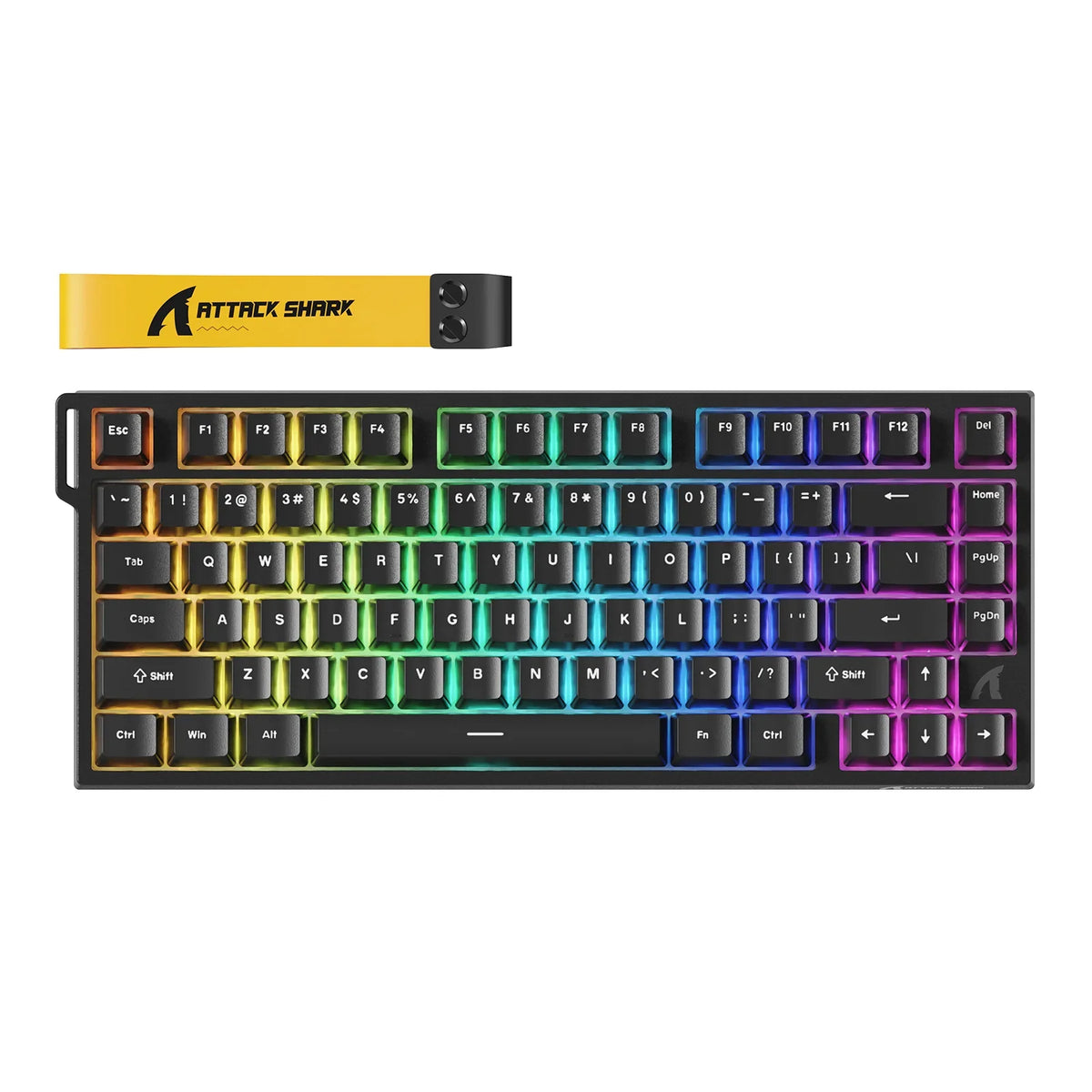
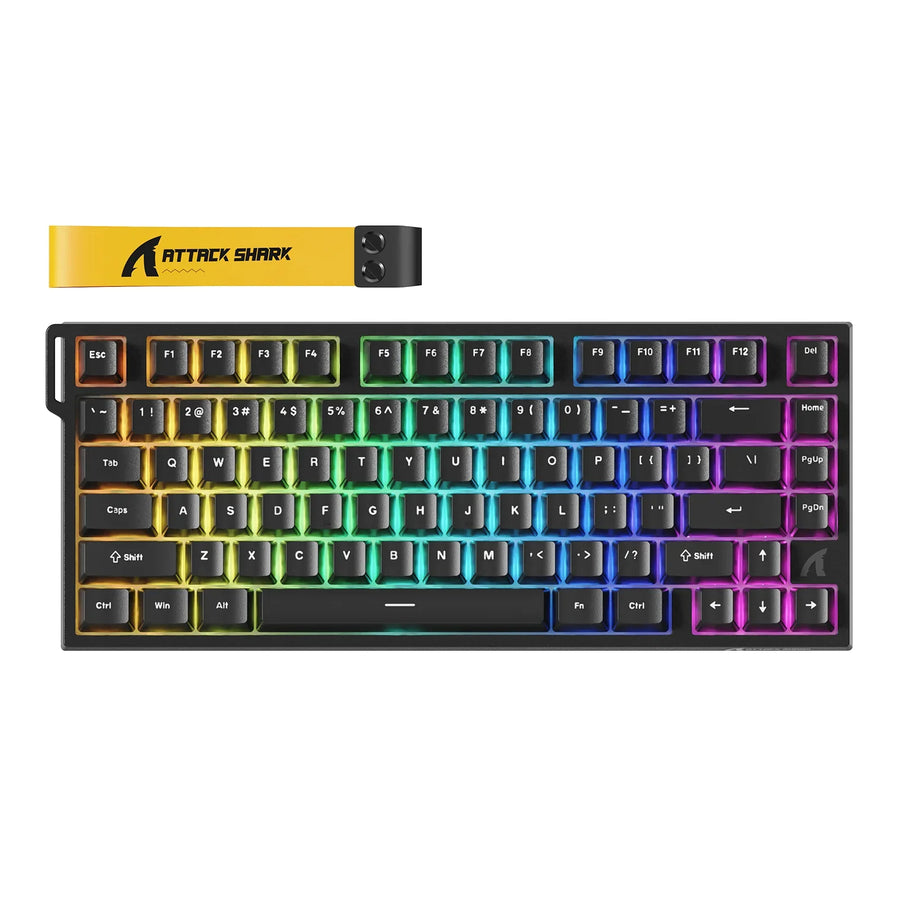
Adjustable actuation changes where a key registers. Rapid trigger changes how the key turns on and off as it moves. On keyboards with magnetic keyboard switches, the first sets a fixed threshold, and the second makes actuation and reset follow your press and release.
They are separate features, not two names for one setting. A keyboard may offer one, both, or its own version of each, so the exact controls depend on the model.
Rapid Trigger vs. Adjustable Actuation: The Core Difference
The key difference is fixed position versus movement. Adjustable actuation answers "how deep before the key counts?" Rapid trigger answers "how does the key respond once it starts moving up or down?"
| Feature | What it changes | What to take from it |
|---|---|---|
| Adjustable actuation | The travel point where a key registers | A chosen depth for "on" |
| Rapid trigger | Actuation and reset based on key movement | On/off follows press and release |
Hall Effect and other analog keyboards can sense how far a switch has traveled. That sensing is what makes both features possible. Wooting's analog-keyboard explanation calls setting the actuation (on) and reset (off) thresholds "configurable or adjustable actuation point." It describes rapid trigger as a step beyond that: the thresholds change on the fly based on whether you mean to press or release.
Neither one is simply "better." They control different parts of the keystroke. A spec sheet that lists both is describing two separate behaviors, and a sheet that lists only one shouldn't be read as offering the other.
What Adjustable Actuation Changes
Adjustable actuation sets the depth at which a key sends its input. You pick a threshold, and the key registers when it travels past that point. A shallow setting means the key counts early in the press. A deeper setting means you have to push farther first.

In the analog-keyboard explanation we're using here, this setting covers the actuation (on) threshold and the reset (off) threshold, and you can apply it to each key or to all of them. The important part is that the threshold stays put once you set it. The key turns on at the same depth on every press, no matter how fast you move or which direction you're going.
That is the line between the two features. Adjustable actuation gives you a fixed reference point. It doesn't make the key react to changes in direction partway through the stroke. Ranges and step sizes differ from one keyboard to the next, so check your model's own specs for the numbers.
What Rapid Trigger Changes as a Key Moves
Rapid trigger makes the key respond to motion instead of fixed points alone. In Wooting's description, the keyboard changes the actuation and reset thresholds based on what you're doing. Pressing down turns the key on. Starting to lift turns it off, even if the key hasn't come back up past a fixed reset point.
Wooting's setup documentation explains the mechanism. Traditional switches use fixed actuation and reset points, while its analog switches can sense which direction the switch is moving. That direction sensing is what rapid trigger relies on. In that implementation, rapid trigger only works below the configured actuation point, which shows how the two features connect: the actuation point decides where rapid trigger starts.
Here is a simple way to picture it. Press a key, let it rise a little, then press again without letting go all the way. With only a fixed reset point, the key may stay on until it rises past that point. With rapid trigger, the small lift can reset the key and the next push can actuate it again. Wooting also offers a sensitivity setting that controls how far you need to let up for a reset. Other keyboards may name or set this differently.
To see how these distances affect timing in practice, our guide to actuation and reset travel covers how to balance the two for combo-heavy play.
FAQs
Does rapid trigger replace the actuation point setting?
No. In the documented implementation, the actuation point still matters because rapid trigger only kicks in below it. Above that depth, the key acts like it has no rapid trigger. You'll often set both.
Can rapid trigger be turned on for only some keys?
On some keyboards, yes. Wooting's documentation describes per-key rapid trigger on its Hall Effect models. It suggests using it on movement keys like WASD and leaving it off keys such as crouch that you might lift by accident. Check whether your keyboard supports per-key control.
Why do these features need Hall Effect or analog switches?
Both depend on the keyboard knowing how far down the key is, and rapid trigger also needs to know which way it's moving. Analog sensing like Hall Effect makes that possible. A standard switch registers at one built-in contact point. If you want to tune either setting, look at our magnetic switch keyboards. For setup ideas by game type, see our guide on setting a magnetic keyboard for gaming.
Is software filtering related to rapid trigger?
They're separate settings, but both depend on the keyboard reading key position. How the sensor signal is smoothed can affect how responsive any position-based feature feels. Our article on software smoothing and raw precision explains that tradeoff.
Check the Exact Keyboard's Documentation
The general difference holds across keyboards. The controls don't always match. Before you buy or start tuning, open the official manual or software guide for your exact model and check three things:
- Availability: Does it list adjustable actuation, rapid trigger, or both?
- Terminology: What does it call each one, and does "rapid trigger" mean movement-based reset there?
- Controls: Can you set them globally or per key, and is there a reset sensitivity setting?
If the documentation only mentions a fixed actuation depth, assume the keyboard doesn't have movement-based reset until the maker says it does. If you're comparing compact models, the spec pages in our 75% HE keyboards range are a good place to check how each feature is listed.