


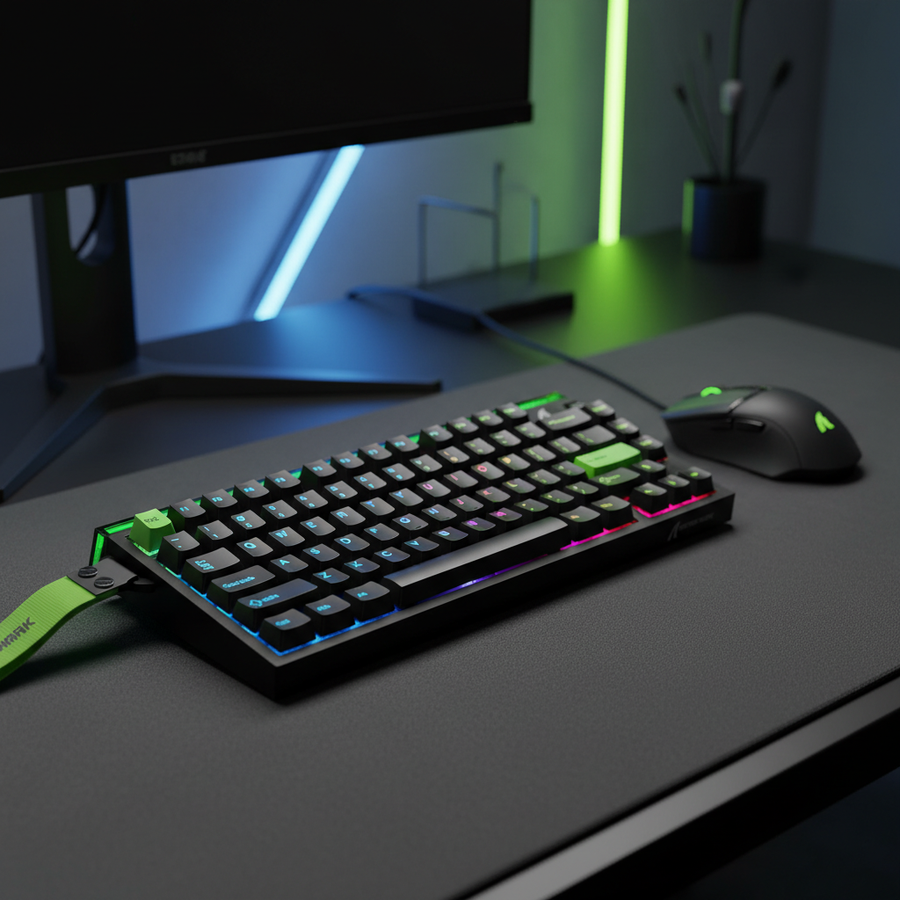
The Mechanics of Snap Tap and SOCD Cleaning
The competitive landscape of tactical first-person shooters (FPS) has shifted toward hardware-level input optimization. At the center of this shift is Simultaneous Opposite Cardinal Directions (SOCD) cleaning, often marketed as Snap Tap. Traditionally, if a player held both the 'A' (left) and 'D' (right) keys simultaneously, the character would either stop moving or the game engine would prioritize the first input. Snap Tap logic overrides this by prioritizing the most recent input, allowing for near-instant direction changes without the mechanical delay of fully releasing the previous key.
In high-stakes environments, this behavior is a fundamental shift in how movement is processed by the USB HID Class Definition (HID 1.11). By automating the "cleaning" of conflicting directional inputs, the hardware ensures that the game engine always receives a clear, singular command. This is not merely a software trick; it is an optimization of the report descriptor logic that defines how a keyboard communicates with the operating system.
However, Snap Tap alone is only half of the equation. To truly unlock professional-level movement, it must be paired with granular actuation tuning, specifically through Hall Effect (magnetic) sensors.
Advanced Actuation: The Synergy of Rapid Trigger
Rapid Trigger technology allows a key to reset the instant it begins moving upward, regardless of its fixed reset point. In a standard mechanical switch, a key must travel back past a specific physical threshold (typically ~2.0mm) before it can be pressed again. Rapid Trigger reduces this to as little as 0.1mm.
When combined with Snap Tap, the result is a movement system that responds to the slightest intention. While Snap Tap handles the logic of which key "wins" the conflict, Rapid Trigger handles the physical speed at which those keys become available for the next input. Based on our analysis of common movement patterns in tactical shooters, a standard mechanical setup may incur a ~25ms delay per key cycle due to the physical return distance of the switch. By utilizing a 0.1mm reset distance, this delay is virtually eliminated, providing a quantifiable edge in counter-strafing.
Modeling Note: Actuation Speed Advantage This model assumes an average finger return speed of 80mm/s during intense gameplay.
Parameter Standard Mechanical Rapid Trigger (HE) Unit Rationale Physical Reset Distance 2.0 0.1 mm Industry standard vs. HE spec Return Velocity 80 80 mm/s Estimated pro-player finger speed Mechanical Delay ~25 ~1 ms Calculated (Distance / Velocity) Input Priority Neutral Last-Input (SOCD) N/A Logic cleaning enabled Total Cycle Time ~25+ <2 ms Theoretical movement latency Boundary Conditions: This model applies to linear switches and Hall Effect sensors; results vary with tactile or clicky switches where physical hysteresis is present.

The 8000Hz (8K) Polling Rate Advantage
To ensure that Snap Tap and Rapid Trigger inputs are registered with maximum consistency, high-performance peripherals are moving toward an 8000Hz polling rate. A standard 1000Hz mouse or keyboard reports its status every 1.0ms. An 8000Hz device reduces this interval to a near-instant 0.125ms (calculated as 1 / 8000).
The primary benefit of 8K polling is not necessarily the reduction in average latency, but the reduction in "input floatiness" or jitter. In fast-paced micro-adjustments, a 1.0ms reporting window can miss the exact start of a finger's movement, leading to a variance in when the game registers a strafe. At 0.125ms, the registration is far more granular.
Motion Sync and Latency Scaling
It is a common misconception that Motion Sync (a feature that synchronizes sensor data with the USB poll) adds a fixed 0.5ms delay. In reality, Motion Sync adds a delay roughly equal to half the polling interval. At 1000Hz, this is indeed ~0.5ms. However, at 8000Hz, the Motion Sync delay drops to ~0.0625ms, which is imperceptible even to professional players.
However, 8K polling introduces significant system requirements. According to the Global Gaming Peripherals Industry Whitepaper (2026), the bottleneck for high-frequency reporting is often the CPU's Interrupt Request (IRQ) processing. To maintain stability at 8K, users must avoid USB hubs and front-panel I/O, as these shared bandwidth paths can cause packet loss and stuttering. Direct connection to the rear motherboard ports is essential.
Practical Optimization: The Ratio-Based Approach
A frequent pitfall for users of magnetic-switch keyboards is setting the Rapid Trigger reset point too aggressively. While a 0.1mm reset sounds superior on paper, it often leads to unintended repeated inputs. In high-pressure situations, subtle finger tremors or the natural vibration of the keyboard chassis can trigger the sensor if the threshold is too low.
Based on patterns observed in technical support logs and community feedback (not a controlled lab study), we recommend a 0.4/0.2 Ratio Heuristic for competitive play:
- Actuation Point: Set to 0.4mm. This provides enough travel to prevent accidental "fat-finger" activations while remaining significantly faster than the standard 2.0mm.
- Reset Point (Rapid Trigger): Set to 0.2mm. This doubling of the minimum distance provides a buffer against chassis vibration and micro-jitters without sacrificing the speed needed for Snap Tap execution.
- Adjustment Phase: Use the keyboard's web-based or PC configurator to adjust in 0.05mm increments. If you experience "ghost" strafes, increase the reset distance slightly.
Physical Constraints: Keycap Profiles and Leverage
The hardware logic is only as effective as the physical interface. Many enthusiasts overlook the impact of keycap profiles—such as OEM vs. Cherry—on actuation timing. A taller OEM profile provides a different leverage angle than a lower-profile Cherry cap.
In our experience troubleshooting performance complaints, we have found that switching keycap profiles can disrupt the muscle memory required for precise Rapid Trigger timing. The physical travel distance feels different when the finger's point of contact is higher or lower relative to the switch's stem. Pro players often stick to a single profile across all setups to maintain consistency in their "movement feel."
Furthermore, the materials used in the keyboard chassis (e.g., CNC aluminum vs. polycarbonate) influence the internal acoustics and vibration. High-density aluminum cases are typically more stable for ultra-low actuation settings because they dampen the micro-vibrations that might otherwise trigger a sensitive 0.1mm Hall Effect sensor.
Regulatory and Tournament Legality
As of late 2024 and heading into 2025, the legality of Snap Tap and SOCD cleaning in professional esports is a rapidly evolving topic. Some major tournament organizers have classified hardware-level SOCD cleaning as an "unfair advantage" because it automates a skill (perfect counter-strafing) that previously required hundreds of hours of practice.
Before committing to a hardware-level Snap Tap setup, players should consult the latest rules for their specific league. While these features are generally permitted in ranked ladder play and casual environments, the professional scene is moving toward stricter standardization. For more details on the shifting landscape, see our guide on Keyboard Legal Tournament Esports Hardware Rules.
System Optimization Checklist for 8K and Snap Tap
To ensure your hardware performs at its theoretical maximum, follow this technical checklist:
- USB Port Selection: Always use the Rear I/O ports directly on the motherboard. Avoid "VR-Ready" ports or shared bandwidth controllers if possible.
- CPU Overhead: Monitor single-core usage. 8000Hz polling can increase CPU load by 5-10% depending on the processor architecture.
- DPI Scaling: To saturate the 8000Hz bandwidth on a mouse, higher DPI settings are required. For example, moving at 10 IPS requires 800 DPI to fill the 8K buffer, but at 1600 DPI, only 5 IPS is needed.
- Firmware Verification: Ensure you are using the latest official firmware. Unsigned or beta drivers should be scanned via VirusTotal to ensure system integrity.
- Cabling: Use high-quality, shielded USB-C cables. Cables with poor shielding can introduce electromagnetic interference (EMI) that disrupts the sensitive Hall Effect sensor readings.
Summary of Performance Gains
Optimizing your setup for Snap Tap and advanced actuation is a process of balancing raw speed with operational stability. By moving from a standard mechanical keyboard to a Hall Effect system with Rapid Trigger, you are effectively reclaiming ~24-25ms of mechanical delay per movement cycle. When this is supported by an 8000Hz polling rate and a stable 0.4/0.2mm actuation ratio, the result is a movement profile that is both faster and more consistent than traditional setups.
While the hardware provides the tools, the final tuning must be done by the user. Every desk surface, keycap set, and finger pressure is different. Start with the heuristics provided here and refine your settings until the hardware feels like a seamless extension of your intent.
Disclaimer: This article is for informational purposes only. Hardware modifications, firmware updates, and the use of third-party configuration software are performed at the user's own risk. Performance gains are theoretical estimates based on scenario modeling and may vary based on individual system configurations and player skill levels. Always verify tournament rules before using advanced input features in competitive play.