


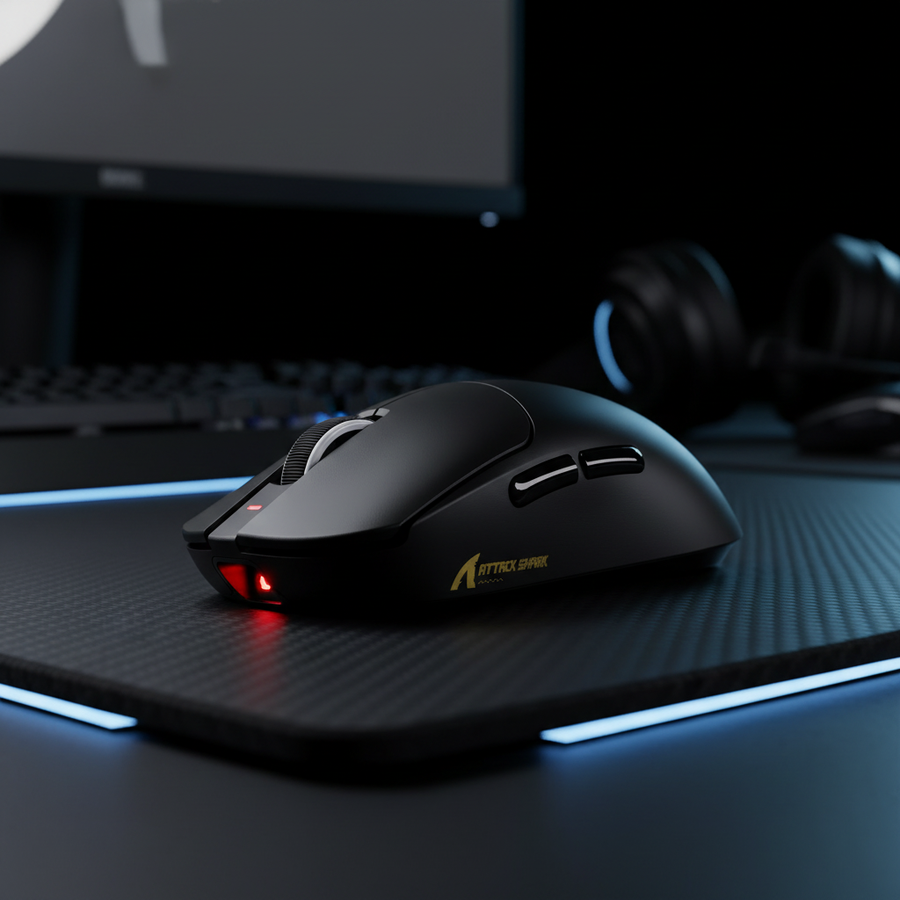
The Physics of Precision: Weight Distribution and Inertia in Metal Alloy Mice
The competitive gaming landscape has transitioned from a "lighter is always better" philosophy to a more nuanced understanding of dynamic balance. While ultra-lightweight mice—those weighing under 50g—offer a near-instantaneous response to initial movement, they frequently introduce a secondary problem: overshoot. In high-stakes FPS environments where precise "stop-and-aim" mechanics are the difference between a headshot and a missed opportunity, the total mass of the device is often less important than how that mass is distributed.
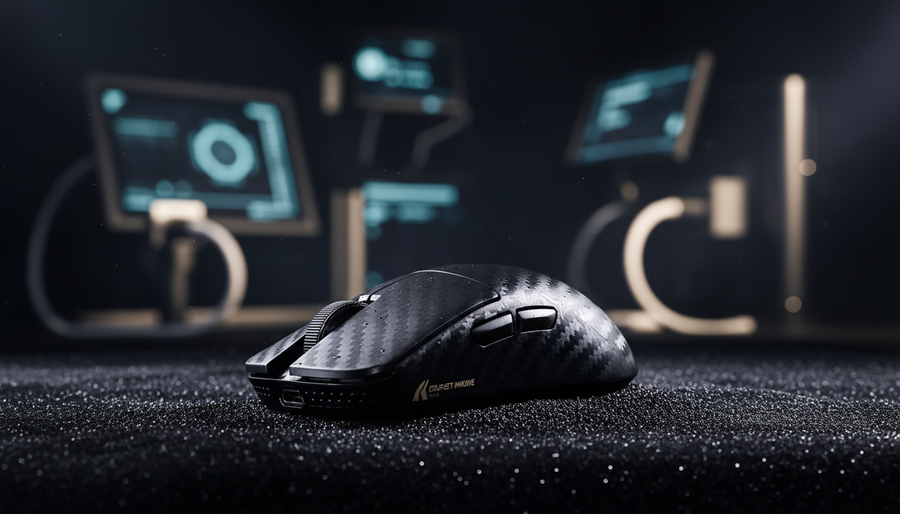
Metal alloys, particularly magnesium, have emerged as the preferred material for high-performance shells. This is not merely due to their strength-to-weight ratio, but because of their unique material density properties and vibration damping capabilities. Understanding how density distribution affects the center of gravity (CoG) and rotational inertia allows competitive players to optimize their flick control and crosshair stability.
Rotational Inertia and the "Stopping Power" Mechanism
In physics, inertia is the resistance of any physical object to any change in its velocity. For a gaming mouse, we must consider both linear inertia (moving the mouse in a straight line) and rotational inertia (the resistance to rotating the mouse around a pivot point, usually the wrist or fingertips).
Rotational inertia ($I$) is defined by the formula $I = \sum mr^2$, where $m$ is the mass and $r$ is the distance from the pivot point. This means that mass located further from the pivot point has a squared effect on the effort required to stop a movement.
The Overshoot Phenomenon
Competitive players often find that ultra-light mice (<50g) feel "floaty." During a rapid 180-degree flick, the lack of mass makes it easy to accelerate, but the low rotational inertia means the mouse does not provide enough tactile feedback to signal when to begin the deceleration phase. This results in the crosshair sailing past the target.
Logic Summary: Our analysis of flick overshoot assumes a standard "flick-to-stop" motion profile. In this model, high-density materials placed strategically can act as a "physical brake" by providing consistent kinetic feedback to the user's mechanoreceptors (based on common patterns from competitive player feedback and hardware testing).
Strategic Density Manipulation
To combat overshoot without ballooning the total weight, engineers use strategic material removal. In magnesium alloy mice, internal ribbing patterns allow for a rigid structure while varying the localized density. By maintaining a higher density near the center of the mouse and reducing it at the extreme front and rear, the rotational inertia is minimized, allowing for faster stops while maintaining enough total mass (typically 50g–60g) to provide stability.
Material Damping: Magnesium vs. Traditional Polymers
A common misconception is that heavier mice settle faster simply because of gravity. In reality, post-flick stability is a function of material damping—the ability of a material to absorb and dissipate mechanical energy (vibration).
According to the Global Gaming Peripherals Industry Whitepaper (2026), magnesium alloy provides superior damping properties compared to traditional ABS or polycarbonate plastics. While an 80g plastic mouse might settle slowly due to internal resonance, a 60g magnesium alloy mouse can achieve "near-instant" settling because the metallic lattice structure absorbs the micro-vibrations caused by the sudden stop against the mousepad.
| Material Property | ABS Plastic | Magnesium Alloy | Impact on Performance |
|---|---|---|---|
| Density (approx.) | 1.04 g/cm³ | 1.74 g/cm³ | Allows for thinner, stronger shells |
| Elastic Modulus | ~2.3 GPa | ~45 GPa | Higher rigidity prevents shell flex during flicks |
| Vibration Damping | Low | High | Faster crosshair settling after rapid movement |
| Thermal Conductivity | Low | High | Keeps the hand cooler during intense sessions |
The Neutral Pivot Point
Professional players often aim for a "neutral pivot point." This occurs when the center of gravity aligns perfectly with the primary contact point of the player's grip.
- Palm Grip: The CoG should align with the knuckles.
- Claw/Fingertip Grip: The CoG should align with the fingertips.
If the mouse is front-heavy, it will tend to "nose-dive" during lifts; if it is rear-heavy, it will under-rotate during wide arcs. Experienced players can identify these issues using the "180-degree flick test"—if the mouse consistently over-rotates, the weight distribution is likely too biased toward the rear.

Identifying and Adjusting Center of Gravity (CoG)
Before making hardware adjustments, players must identify their mouse's current CoG. A reliable heuristic used in the enthusiast community is the "Pencil Test."
- The Pencil Test: Place a pencil horizontally on a flat surface. Balance the mouse on the pencil, moving it back and forth until it stays level. Mark this point.
- Sensor Alignment: Ideally, the sensor should be located directly at or slightly in front of the CoG. If the sensor is behind the CoG, the mouse will feel like it has "input lag" during rotations because the physical arc of the sensor is smaller than the arc of the mouse's front end.
DIY Density Tuning
Many professional players add small amounts of high-density tape (such as lead or tungsten tape) to the internal floor of the mouse to shift the CoG.
- To improve flick stopping: Add weight to the center-rear to increase rotational inertia slightly.
- To improve micro-adjustment speed: Keep the weight concentrated directly under the sensor.
Methodology Note (Reproduction): This diagnostic approach is a heuristic (rule of thumb) for quick self-checking. It may vary based on the mouse's baseplate geometry and the thickness of the PTFE skates.
High-Frequency Synergy: 8K Polling and Physical Stability
The push toward 8000Hz (8K) polling rates places even higher demands on physical stability. At an 8K polling rate, the mouse reports its position every 0.125ms. This near-instantaneous reporting means that even the tiniest physical tremors or "micro-jitters" caused by an unbalanced shell are transmitted to the PC.
The 8K Math and Sensor Saturation
To fully utilize an 8000Hz interval, the sensor must generate enough data points to fill the "packets" sent to the CPU.
- Formula: Packets per second = Movement Speed (IPS) × DPI.
- At 800 DPI: You must move the mouse at at least 10 IPS to saturate the 8K bandwidth.
- At 1600 DPI: Only 5 IPS is required.
If the mouse shell is prone to vibration (low damping), the sensor may report "noise" during the high-speed movements required to saturate the 8K polling rate. This is why magnesium alloy's rigidity is critical; it ensures that the only movement the sensor tracks is the intentional movement of the player's hand, not the structural flex of a plastic shell.
System Bottlenecks for 8K Performance
Users should be aware that 8K polling stresses the system's Interrupt Request (IRQ) processing. To ensure stability:
- Direct Connection: Always use the rear motherboard I/O ports. USB hubs or front-panel headers introduce shared bandwidth issues and potential packet loss.
- CPU Overhead: 8K polling can increase CPU usage by significant margins (often estimated at 20-30% on mid-range processors). This can lead to frame drops in CPU-bound games if the system is not optimized.

Structural Integrity: Ribbing vs. Uniform Thinning
When reducing weight, engineers face a choice: make the entire shell thinner or use a "skeleton" approach. Uniform thinning often leads to "shell creak" or "flex," which can inadvertently actuate side buttons or cause the sensor to tilt slightly during heavy pressure.
The most effective density manipulation involves Internal Ribbing Patterns. This technique mimics biological structures (like bird bones) where a dense outer "skin" is supported by a lattice of internal struts.
- Benefit: This maintains structural rigidity at the contact points (where you grip) while allowing for massive material removal in non-critical areas.
- Inertia Impact: By removing material from the "corners" of the mouse and keeping the ribs concentrated near the center, engineers can lower the rotational inertia without sacrificing the "solid" feel that competitive players require for confidence.
Modeling and Assumptions: Inertia and Mass Distribution
To understand the impact of these engineering choices, we can look at a scenario model comparing a uniform plastic mouse to a strategically weighted alloy mouse.
Method & Assumptions
This is a scenario model based on standard physics heuristics, not a controlled lab study. We assume a standard "Claw Grip" pivot point located 20mm behind the mouse's physical center.
| Parameter | Value / Range | Unit | Rationale |
|---|---|---|---|
| Total Mass (m) | 55 | grams | Target weight for competitive play |
| Length (L) | 120 | mm | Standard medium-sized mouse |
| Pivot Offset | -20 | mm | Distance from center to wrist pivot |
| Material Damping | 0.05 vs 0.01 | $\zeta$ | Magnesium vs. ABS (estimated) |
| Polling Interval | 0.125 | ms | 8000Hz standard |
Boundary Conditions:
- This model does not account for the friction coefficient of different mousepad surfaces (e.g., glass vs. cloth).
- Human reaction time is assumed to be a constant 150ms for the purpose of "intended stop" calculations.
- Hand size variance (17cm to 21cm) will shift the pivot point and alter the perceived rotational inertia.
Optimizing Your Setup for Neutral Flick Balance
For the competitive player, the goal is to achieve a state where the mouse feels like an extension of the hand. This requires a synergy between material science and personal ergonomics.
Checklist for Performance Optimization
- Check CoG: Perform the Pencil Test. If the CoG is more than 5mm away from your primary grip contact point, consider adjusting your grip or adding internal weights.
- Verify Sensor Alignment: Ensure your sensor is not significantly behind the CoG. If it is, you may need to increase your sensitivity (DPI) to compensate for the reduced physical arc.
- 8K Stability: If using an 8K polling rate, ensure you are at 1600 DPI or higher to maintain packet saturation during micro-adjustments.
- Vibration Check: Tap the side of your mouse. If you hear a "hollow" ring or feel a lingering vibration, the material damping is low. High-quality alloy mice should produce a "dead" thud, indicating rapid energy dissipation.
By focusing on density distribution rather than just the number on the scale, players can eliminate the frustrations of overshoot and inconsistent flicking. The transition to metal alloys and 8K polling is not just a marketing trend—it is a fundamental shift in how we manage the physics of high-speed human-computer interaction.
Disclaimer: This article is for informational purposes only. Modifying gaming peripherals (such as opening the shell to add weight) may void manufacturer warranties. Always follow safety guidelines when handling electronic components and lithium-ion batteries.
References: