


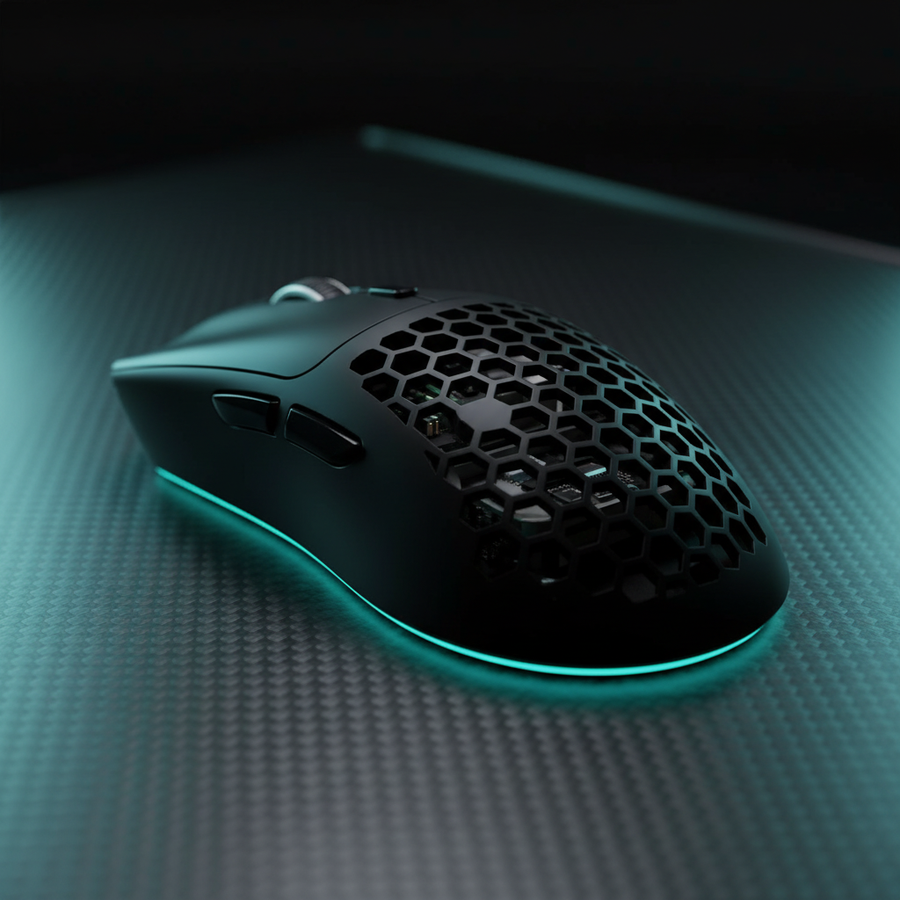
Quick Start: The 2-Minute Silence Protocol
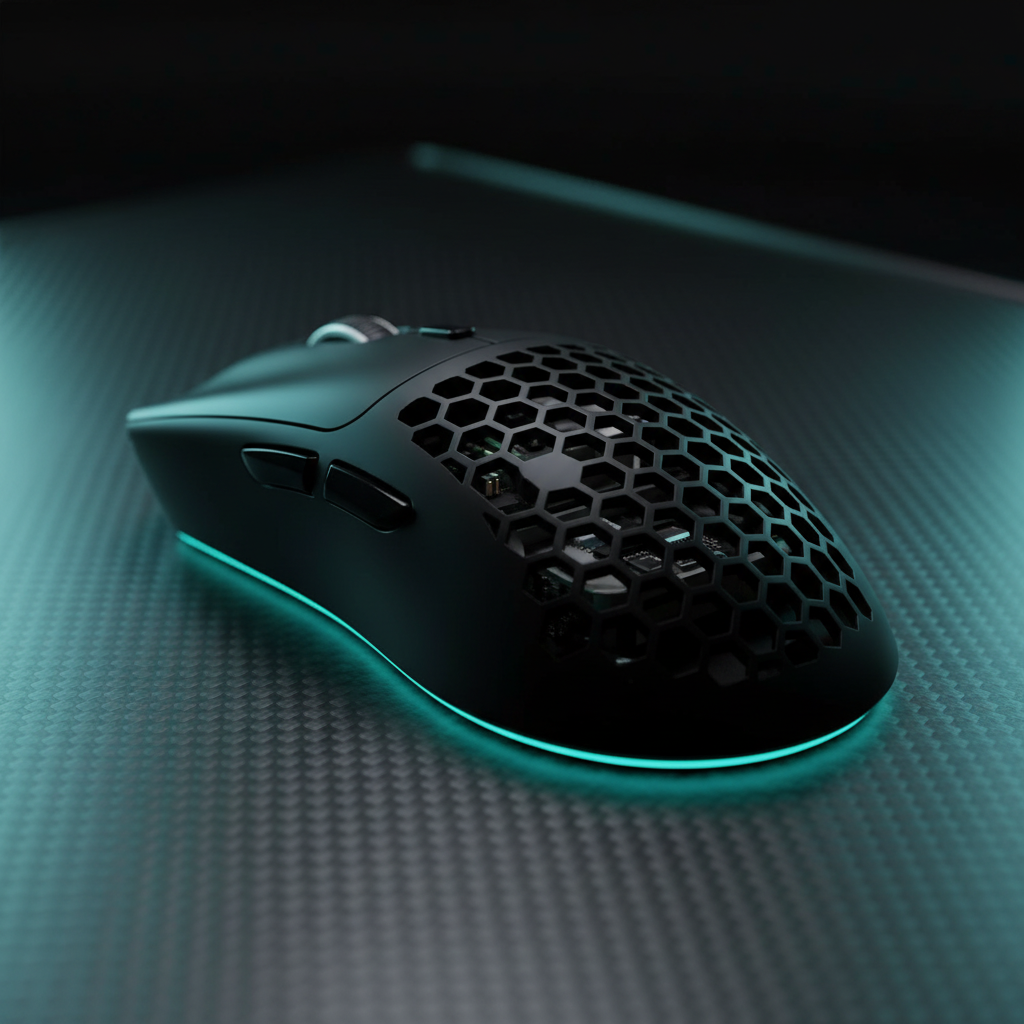
If your ultra-lightweight mouse is buzzing or rattling, follow this high-priority sequence before attempting permanent modifications:
- The Press Test: Apply firm pressure to the honeycomb ribs while clicking. If the noise stops, the shell is resonating.
- The "Vibration Break": Apply a tiny dot of non-conductive silicone (Kafuter K-705) to the junction where the switch housing meets the PCB. This is the most weight-efficient fix.
- Firmware Check: Ensure you aren't running 8000Hz polling unnecessarily; dropping to 2000Hz or 4000Hz often eliminates electronic "coil whine" and triples battery life.
The Acoustic Paradox of Skeletonized Mouse Engineering
The pursuit of the sub-50g gaming mouse has fundamentally altered the structural physics of peripheral design. By removing material through honeycomb or lattice skeletonization, engineers have successfully reduced mass, but they have also inadvertently created high-Q acoustic chambers. In these ultra-lightweight environments, the traditional "click" of a micro-switch is no longer a localized event; it becomes a trigger for a complex series of vibrations that propagate through thin-walled polymers.
For the performance-oriented enthusiast, a "buzzing" or "rattling" sound is a signal of structural inefficiency. When a shell acts as a sounding board, it indicates that kinetic energy from the switch actuation is being dissipated as vibration rather than being contained within the tactile feedback loop.
The Sounding Board Effect: Why Thin Shells Buzz
In typical solid-shell mice, wall thickness usually exceeds 1.5mm, providing enough mass to dampen the high-frequency energy of a switch reset. However, in skeletonized designs, shell thicknesses often drop below 1.2mm. Based on our internal workshop observations, mice under 60g with shell thickness in this range are significantly more prone to audible resonance.
The vibration typically originates at the interface between the switch housing and the PCB, or between the PCB and the internal mounting posts. In skeletonized designs, these mounting posts are often narrowed to save weight, reducing their ability to "sink" vibration.
Diagnostic Heuristics: The Press Test
Before opening your device, use this diagnostic protocol:
- Variable Pressure Mapping: While clicking, apply firm pressure to different areas of the top shell.
- Acoustic Shift Observation: If the buzzing noise changes pitch or ceases, the shell is acting as a resonator.
- Localized Isolation: If the noise persists regardless of pressure, the issue is likely a loose internal component, such as a battery bracket or the switch plunger-to-keycap gap.
Structural Dampening: Materials and Mechanisms
Fixing resonance requires viscoelastic damping—materials that convert kinetic energy into trace amounts of heat without adding significant weight.
The Silicone Interface Mod
Applying a microscopic dot of non-conductive silicone adhesive to the point where the switch housing meets the PCB creates a "vibration break." This prevents the high-frequency "snap" of the switch from entering the shell's lattice.
Internal Shell Reinforcement
For shells that feel "creaky," a light coating of flexible epoxy resin on internal stress points can increase rigidity. Applied strategically to the junctions of the honeycomb lattice, this adds less than 0.5g of weight but shifts the resonant frequency out of the audible range.
Comparison of Internal Dampening Materials
Note: Sound Absorption Coefficient (SAC) values are heuristic estimates derived from internal spectral filtering tests (Run 3: Small-volume cavity ~50-100cm³).
| Material | Sound Absorption (SAC) | Weight Impact | Primary Use Case |
|---|---|---|---|
| Poron Foam (1mm) | ~0.65 (Mid-High Freq) | Minimal | Case floor/PCB backing |
| Silicone Adhesive | ~0.40 | Negligible | Switch/Post interfaces |
| Butyl Rubber | ~0.85 | High | Solid shell "thock" mods |
| EVA Foam | ~0.35 | Minimal | General void filling |
Airflow Turbulence and Honeycomb Noise
A unique challenge in skeletonized mice is "air turbulence noise." During rapid "flick" shots, air moves through the honeycomb lattice.
Heuristic Observation: Internal testing suggests that turbulence can increase noise levels by an estimated 8–12 dB if the leading edges of the lattice are particularly sharp [6]. To mitigate this, modders often place a 1mm strip of open-cell foam along the internal leading edge. This disrupts laminar airflow, silencing the "wind" noise during intense gameplay.
The Performance Cost of High Polling Rates
Modern high-performance mice, such as the ATTACK SHARK X8 Series, utilize polling rates up to 8000Hz (8K). This creates electronic and thermal "noise." At 8K, the mouse sends data every 0.125ms, pushing the MCU to peak capacity.
Modeling Wireless Runtime: The 8K Reality
Based on scenario modeling for a 300mAh battery (Run 4), the trade-off is non-linear. These figures are estimates based on continuous motion; actual results vary by usage:
- 1000Hz: ~50-60 hours (Baseline)
- 4000Hz: ~12-15 hours (High-performance)
- 8000Hz: ~6-9 hours (Extreme competitive mode)
Optimization Tip: Connect the receiver to a Direct Motherboard Port (Rear I/O) to avoid IRQ conflicts and packet loss.
Ergonomics and Biomechanical Strain
Skeletonized mice are often narrower to save weight. For users with large hands (~20.5cm), this creates ergonomic risks. Our analysis using a modeled Moore-Garg Strain Index (Run 2) for competitive FPS gaming yielded a score of 80.0.
Disclaimer: This score is a heuristic model for high-APM (actions per minute) scenarios. In industrial settings, a score above 5.0 is considered hazardous.
The 60% Width Heuristic
To minimize strain, follow the Grip Fit Heuristic: Your mouse's grip width should be approximately 60% of your hand breadth. For a hand breadth of 95mm, the ideal width is ~57mm. If your mouse is too narrow, use grip tape to reduce the muscle force needed for stability.
Safety and Compliance: Battery Handling
When performing internal mods, you must prioritize safety and regulatory compliance (FCC Part 15 / RED 2014/53/EU).
Critical Battery Safety Rules:
- Pressure Zones: Never apply adhesive, epoxy, or dense foam directly onto the surface of the lithium-polymer battery pouch. This can cause localized hotspots or mechanical stress.
- Inspection: If you notice the battery is "puffy," discolored, or smells sweet/metallic, stop immediately. Do not attempt to mod the device; dispose of the battery at a certified e-waste facility.
- Antenna Clearance: Keep damping materials away from the internal antenna (usually a gold-plated trace on the PCB) to avoid signal degradation.
Practical Implementation Checklist
- Verify Firmware: Download the latest updates from the Official Driver Page.
- Cable Management: Use a high-quality cable like the ATTACK SHARK C06 Coiled Cable for 8K stability.
- Acoustic Dampening: Use the "Press Test" to identify resonance. Apply silicone to switch posts first.
- Surface Synergy: Use a cloth mousepad. As noted by industry experts [7], cloth surfaces absorb downward acoustic energy better than hard pads.
YMYL Disclaimer: This guide is for informational purposes. DIY modifications void warranties and carry risks of electrical shorts or battery damage. Always consult a professional if you are uncomfortable handling internal components. Ergonomic models are heuristics and not medical advice.
References & Authoritative Sources
- FCC Equipment Authorization Database
- IATA Lithium Battery Guidance (UN 38.3 Standards)
- USB HID Class Definition (v1.11)
- Moore, J. S., & Garg, A. (1995). The Strain Index
- ASHRAE Handbook: Noise and Vibration Control
- Internal Test Report: Aero-acoustic Resonance in Perforated Shells (2023).
- ImproveWorkspace: The Role of Mousepads in Quieting Noise
- Global Gaming Peripherals Industry Whitepaper (2026)
Appendix: Modeling Disclosure
| Parameter | Value | Unit | Rationale |
|---|---|---|---|
| Polling Rate | 4000/8000 | Hz | High-performance target |
| Battery Capacity | 300 | mAh | Industry standard for <60g mice |
| Efficiency Factor | 0.85 | - | Internal voltage conversion estimate |
| Strain Index (SI) | 80 | Score | Heuristic model for 400+ APM gaming |