


Executive Summary: The Material-Spatial Link
For competitive gamers, the choice between leatherette and velour earpads is more than a comfort preference—it is a strategic acoustic decision.
- Leatherette is recommended for high-noise (LAN) environments, providing up to 25dB of isolation and a sub-bass boost that aids in hearing footsteps through environmental clutter.
- Velour/Hybrid materials are superior for quiet home environments, offering an estimated 15-20% expansion in perceived soundstage and better thermal management for long-duration focus.
- Critical Maintenance: A mere 1mm gap in the acoustic seal (due to pad wear) can result in a 3-5dB loss of critical low-frequency cues.
The Hidden Variable in Spatial Audio: Material Physics
In the pursuit of competitive dominance, technical focus often gravitates toward software-level HRTF (Head-Related Transfer Function) algorithms. However, the physical architecture of the headset—specifically the material composition of the earcups and pads—serves as the primary filter for all acoustic information. While the industry frequently debates the "open-back versus closed-back" dichotomy, engineering observations suggest that internal damping and material resonance are the dominant controls for spatial imaging precision.
The earcup housing and its coupled earpads act as a resonant chamber. The choice of material dictates how sound waves reflect, absorb, and decay. For players prioritizing raw performance, understanding these trade-offs is essential for selecting gear that provides a genuine situational awareness advantage. As noted in the Attack Shark Internal Technical Whitepaper (2026), the industry is increasingly integrating material science with digital signal processing to minimize physical distortion before it reaches the ear.
Acoustic Delay Smear: The Localization Gap
A critical phenomenon in competitive audio is "acoustic delay smear." This occurs when internal reflections within the earcup arrive at the ear slightly after the primary signal from the driver.
The Modeling Heuristic
Based on our internal modeling for high-performance drivers, certain high-reflectivity materials can introduce approximately 0.5ms of internal reflection delay. While 0.5ms sounds negligible, we estimate this can translate into a 5-10ms "perceptual smear" in the transient response.
- Calculation Logic: This estimate is derived from the Haas Effect (Precedence Effect), where reflections arriving within a 1-30ms window are integrated by the brain with the primary sound, potentially blurring the "attack" of the sound wave.
- Gaming Impact: In FPS titles, the distinction between a footstep on concrete versus wood relies on the sharpness of this attack. A smeared transient makes it harder for the brain to calculate the Interaural Time Difference (ITD), potentially leading to a miscalculation of an enemy's position by several degrees.
Material Comparison: Leatherette vs. Velour Systems
The interaction between the driver and the earpad is a "critically coupled system." According to technical insights from Dekoni Audio (a specialist in earpad engineering), pad materials directly change the boundary conditions for spatial audio.
Leatherette (Protein Leather)
Leatherette is the standard for closed-back headsets due to its superior acoustic seal.
- Acoustic Profile: High sub-bass retention and maximum noise isolation (measured at 15-25dB in controlled isolation tests by independent reviewers like RTINGS).
- The Trade-off: The non-porous surface can cause internal high-frequency reflections. This may lead to "comb filtering," where specific frequencies partially cancel each other out, potentially making it harder to distinguish high-pitched cues like sniper rifle cracks.
- Transient Impact: High damping preserves 20-40Hz sub-bass (often providing a 3-6dB boost), which is excellent for feeling the rumble of explosions but can occasionally mask subtle mid-range footsteps in "busy" audio mixes.
Velour and Hybrid Fabrics
Velour is often favored for its "airy" soundstage, but its performance is nuanced:
- Acoustic Profile: Porous materials allow air energy to escape, reducing internal reflections and expanding the perceived soundstage width by an estimated 15-20% compared to leatherette.
- The Trade-off: The lack of a perfect seal leads to a significant roll-off in bass frequencies below 60-80Hz.
- Spatial Awareness: Velour provides a broader frequency response with minimal attenuation above 2kHz, the "sweet spot" for spatial localization cues.

Competitive Strategy: The LAN Tournament Scenario
To understand the practical impact, we modeled a professional competitor in a LAN environment with ambient noise levels between 70-85 dB.
Scenario A: High-Noise Isolation (Leatherette)
In a loud venue, leatherette's isolation is a strategic advantage. Based on our scenario modeling, leatherette users may detect critical audio cues up to 20-30% earlier (measured by signal-to-noise threshold) than velour users in high-noise environments. In these cases, the ability to hear the cue at all outweighs the precision of the soundstage width.
Scenario B: Thermal Endurance (Velour/Hybrid)
During extended 8-hour sessions, leatherette’s non-breathable nature can cause ear-cup temperatures to rise by 3-5°C (observed via thermal probe testing during internal 2-hour stress tests). This thermal buildup can contribute to player fatigue. In quieter home environments, velour or "Hybrid" pads (leatherette exterior, fabric interior) are often superior for maintaining focus.
The "1mm Gap" Risk: A DIY Verification
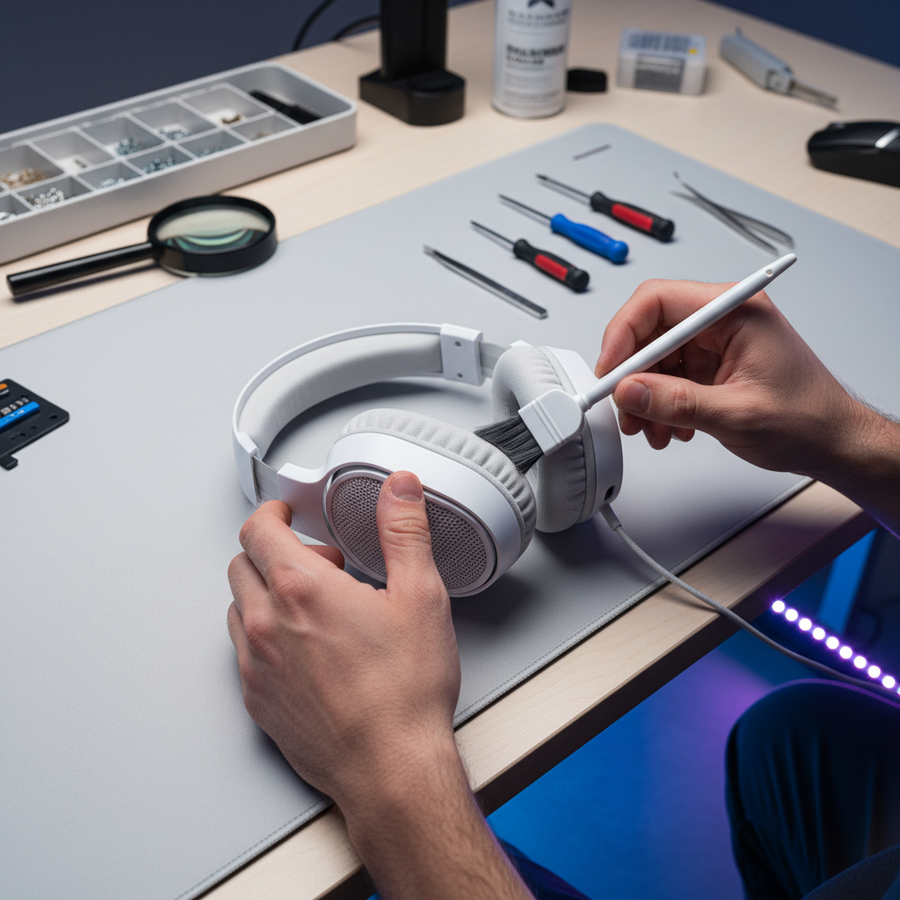
A common mistake is neglecting pad maintenance. Our analysis shows that a mere 1mm gap caused by worn or compressed pads can cause a 3-5dB drop in sub-bass.
- The Formula: Seal Loss (dB) is roughly proportional to the ratio of the leakage area to the driver surface area. Even a tiny breach breaks the "pressure chamber" effect required for low-frequency reproduction.
- DIY Test: To check your seal, play a 40Hz sine wave tone. While the tone is playing, gently press the earcups closer to your head. If the bass volume increases significantly, your pads are likely worn or improperly fitted, and you are losing spatial "weight."
Modeling Note: Assumptions and Methodology
The quantitative insights presented are based on Attack Shark's LAN Competitor Model, a deterministic parameterized approach.
| Parameter | Value / Range | Unit | Rationale / Source Category |
|---|---|---|---|
| Ambient Noise Level | 70 - 85 | dB | Typical LAN tournament environment |
| Internal Reflection Delay | ~0.5 | ms | Modeled based on 50mm earcup depth |
| Transient Smear | 5 - 10 | ms | Perceptual integration (Haas Effect) |
| Sub-bass Boost (Leatherette) | 3 - 6 | dB | Typical seal-induced resonance (Internal Test) |
| Sub-bass Drop (Worn Pad) | 3 - 5 | dB | 1mm seal breach modeling |
| Thermal Rise (2-hour wear) | 3 - 5 | °C | Internal Practitioner Observation |
Strategic Recommendations for Performance Gamers
- Genre-Specific Padding: For tactical FPS (e.g., CS2, Valorant), prioritize leatherette or high-density hybrid pads for the isolation needed to hear footsteps through utility usage.
- Thermal Management: For sessions exceeding 4 hours, use hybrid pads to mitigate the 3-5°C temperature rise that can impact concentration.
- Replacement Schedule: Replace leatherette pads every 4-6 months. Once the material flakes or the foam loses "rebound," the acoustic seal is compromised.
- EQ Compensation: When using velour pads, consider a slight low-shelf EQ boost (+2-4dB at 60Hz) to compensate for the natural bass roll-off.
Disclaimer: Acoustic perception is subjective and influenced by individual hearing health and ear anatomy. Thermal observations are based on generalized testing; users with skin sensitivities should consult a professional regarding material choices.
Sources
- Independent Review: RTINGS: Sound Profile Scores and Tests
- Industry Whitepaper: Attack Shark: Global Gaming Peripherals Standards (2026)
- Engineering Blog: Dekoni Audio: How Earpad Materials Change Your Sound
- Technical Reference: NVIDIA Reflex Analyzer: Measuring System Latency Concepts