




Executive Summary
Verdict: Dual-rail (boxed) switches significantly reduce lateral stem wobble (<0.2mm) compared to standard cross-stems, offering measurable benefits for acoustic consistency and vertical travel smoothness. Best For: High-APM FPS gamers using "claw" grips and enthusiasts seeking to eliminate high-frequency rattle. Limitations: Tighter tolerances (±0.05mm) require precise lubrication; over-lubing can cause hydraulic binding.
The Mechanics of Stability: Why Dual-Rail Stem Design Matters
In the pursuit of the ultimate tactile experience, advanced gamers and keyboard enthusiasts have shifted their focus from simple actuation force to the nuances of mechanical switch geometry. Among these innovations, the dual-rail stem design—often characterized by "box" or "walled" stems—has emerged as a technical benchmark for precision. While the standard MX-style cross stem has served the industry for decades, its inherent vulnerability to lateral movement, or "stem wobble," creates significant friction points for high-performance users.
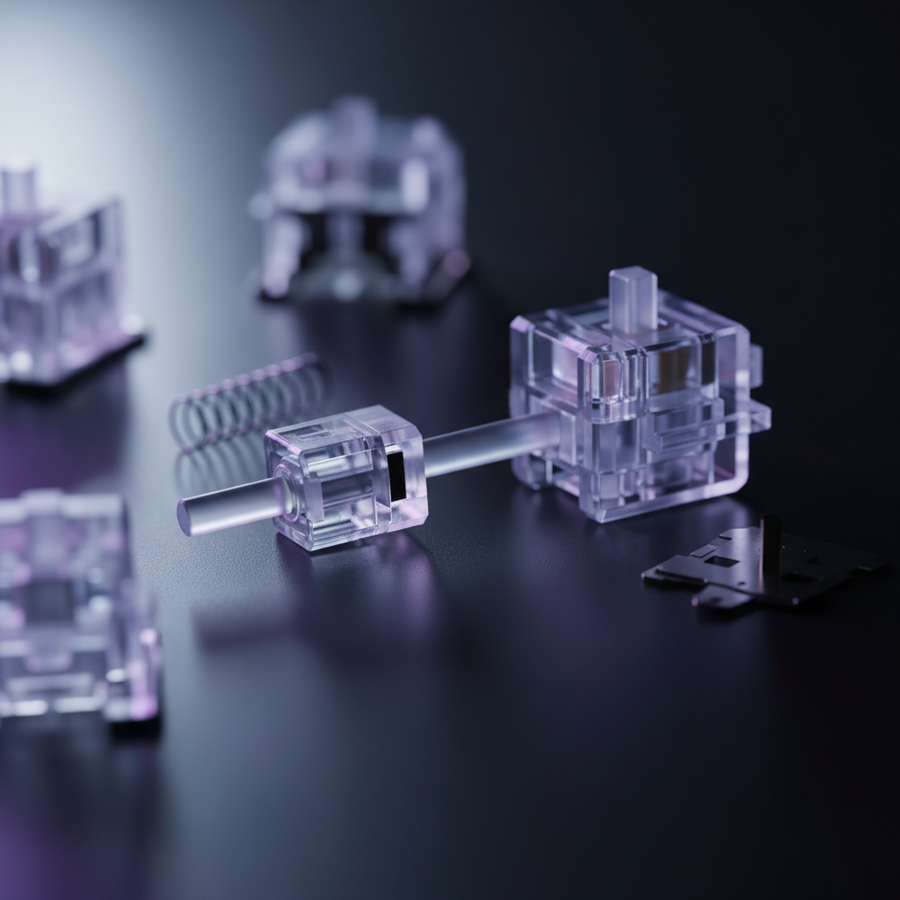
The dual-rail architecture addresses a fundamental engineering challenge: maintaining a strictly vertical travel path. By integrating two parallel guide rails that interface with the switch housing, the design minimizes the lateral play that typically occurs when a key is pressed off-center. For gamers executing rapid, high-intensity inputs, this precision is not merely an aesthetic preference; it is a mechanism for reducing physical binding and ensuring consistent actuation. According to manufacturer industry analysis (see Global Gaming Peripherals Industry Whitepaper 2026), the sector is moving toward tighter tolerance standards where even a 0.05mm variance in rail-to-guide channels (measured via optical comparators) can be detected by experienced typists.
Engineering Precision: Dual-Rail vs. Traditional Stem Architecture
To understand the advantage of dual-rail stems, one must analyze the physics of a traditional single-rail cross stem. In a standard switch, the stem is stabilized primarily by the center pole and the internal housing walls. However, the clearance required for smooth movement often allows for lateral "tilt."
The 0.5mm Threshold and Lateral Play
Research into switch stability indicates that stem wobble exceeding ~0.5mm of lateral play (measured at the keycap edge) can lead to accelerated wear and inconsistent feel. In a dual-rail design, the "walls" or "rails" on the side of the stem act as additional stabilization points. This creates a larger surface area for guidance, which effectively "locks" the stem into a vertical trajectory.
| Feature | Traditional Single-Rail | Dual-Rail (Walled/Box) |
|---|---|---|
| Lateral Stability | High variance (~0.5mm+ play)* | High precision (<0.2mm play)* |
| Surface Area | Minimal (Center-focused) | Expanded (Side-stabilized) |
| Off-Center Press | Potential for "binding" | Smooth vertical travel |
| Acoustic Profile | Prone to "ticking" artifacts | Consistent "clack" or "thock" |
| Keycap Wear | Higher (due to lateral tilt) | Lower (consistent vertical force) |
*Values based on typical enthusiast caliper measurements comparing standard MX clones vs. premium boxed switches.
Logic Summary: The transition from single-point stabilization to multi-point rail guidance reduces the "lever effect" during off-center keypresses. This is particularly critical for larger keycaps (like Shift or Enter) where the force is rarely applied perfectly over the center of the switch.

Biomechanical Impact: The FPS Gamer Scenario
The technical benefits of dual-rail stems are most pronounced during high-APM (Actions Per Minute) gaming. Competitive FPS players frequently utilize a "claw" or "fingertip" grip, which often results in forceful, off-center strikes during rapid strafing (WASD) or flick-shot sequences.
Scenario Modeling: The Large-Handed Gamer
Our analysis focuses on a specific user persona: the competitive FPS gamer with large hands (~20.5cm length). In this scenario, the biomechanical stresses are amplified. When using a claw grip, the angle of the finger often applies force at a diagonal rather than a straight vertical.
- Muscular Stabilization: On a switch with pronounced wobble, the gamer’s hand must exert additional micro-stabilization to maintain keycap alignment. This is a non-obvious cause of forearm fatigue.
- Input Consistency: A single-rail stem might "bind" against the housing if pressed at an extreme angle, leading to a "gritty" sensation that can disrupt the near-instant 1ms response time required for competitive edge.
- Strain Index Analysis (Theoretical Model): Using the Moore-Garg Strain Index (a method to estimate risk of distal upper extremity disorders), a high-intensity gaming workload can theoretically reach a score of 27.0. This score is derived from the following multipliers: Intensity (3) × Duration (1) × Frequency (3) × Posture (2) × Speed (1.5) × Day Duration (1). A score >5 is generally classified as "Hazardous." Reducing the stabilization force required by the fingers through more stable switches is one factor in mitigating this risk.
Methodology Note: This scenario modeling assumes a high-APM workload (200-300 actions per minute) over 4-8 hours per day. The SI score reflects the cumulative impact of intensity, frequency, and posture during competitive play, rather than a clinical diagnosis.
Acoustic Signatures and Frequency Damping
Enthusiasts often prioritize the "sound" of a keyboard, but acoustics are deeply tied to mechanical tolerances. Stem wobble is a primary contributor to inconsistent high-frequency "ticks" or rattles. When a stem has excessive lateral play, it can impact the side of the housing before or during bottom-out.
Thock vs. Clack: The Spectral Filter
Acoustic analysis suggests that dual-rail designs help attenuate high-frequency artifacts (>2000Hz), often described as "clack." By minimizing extraneous movement, the sound profile becomes more predictable and "cleaner."
- Low-Frequency ( < 500Hz): Known as "thock," this is achieved through material density and housing volume.
- High-Frequency ( > 2000Hz): Known as "clack" or "tick," this is often the result of stem-to-housing impact caused by wobble.
Dual-rail switches, such as those found in premium high-performance builds, often use a combination of POM (Polyoxymethylene) stems and PC (Polycarbonate) housings. The self-lubricating nature of POM on the dual rails ensures that the vertical travel remains smooth over millions of cycles, maintaining the acoustic integrity of the switch.
The Interaction Between Keycaps and Stem Stability
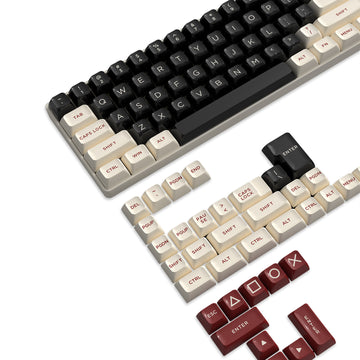
The choice of keycaps significantly influences the perceived stability of a switch. High-quality PBT keycaps, such as the ATTACK SHARK 149 Keys PBT Keycaps Double Shot Full Keycap Set, provide the rigidity and weight needed to complement a dual-rail stem.
Keycap Stem Wear and Fitment
A common heuristic in the enthusiast community is that switches with over 0.5mm of lateral play can accelerate the wear on keycap stems. When a keycap tilts excessively, the internal cross-mount of the keycap is subjected to uneven stress. Over time, this can lead to "loose" keycaps that wobble even more, creating a negative feedback loop of instability.
Using a set like the ATTACK SHARK 120 Keys PBT Dye-Sublimation Pudding Keycaps Set on a dual-rail switch ensures that the force is distributed evenly across the MX structure. This is particularly important for "Pudding" style caps where the translucent lower half requires structural integrity to maintain its aesthetic and functional performance.
For those looking to add a touch of customization without sacrificing the ergonomic benefits of the OEM profile, the ATTACK SHARK Custom OEM Profile PBT Colored Keycaps offer a way to highlight specific gaming zones (like WASD) while benefiting from the anti-grease properties of high-grade PBT.

Manufacturing Realities: The Precision Gap
While "dual-rail" is a powerful marketing term, the actual benefit is highly dependent on manufacturing tolerances. Expert builders note that a poorly executed dual-rail switch can actually feel worse than a high-precision single-rail switch.
The Lubrication Conflict
There is a potential trade-off between tight tolerances and smoothness. Lubricant aims to reduce friction, while tight tolerances aim to eliminate play. If the tolerances are too tight, the lubricant can actually introduce "drag" or "stiction" (static friction) as it accumulates dust or degrades over time.
Practitioners often observe:
- Factory Lube Consistency: Switches with dual rails require precise application. Excessive lube in the rail channels can lead to a "mushy" feel.
- Wear-In Period: Dual-rail stems may require a longer "break-in" period to smooth out microscopic imperfections in the plastic-on-plastic interface.
Professional Insight: Based on patterns from community feedback and repair benches, the most common mistake is over-lubing the side rails of a boxed switch. A light, consistent layer is superior to a heavy coating, which can cause hydraulic resistance within the tight 0.05mm (estimated) gaps.
Performance Synergy: 8K Polling and Switch Latency
For the advanced gamer, the physical stability of the switch is the first step in a chain of high-performance data processing. When paired with an 8000Hz (8K) polling rate system, the importance of a clean, decisive actuation becomes paramount.
The 0.125ms Window
At an 8000Hz polling rate, the system checks for inputs every 0.125ms (1ms / 8 cycles). If a switch has excessive wobble or "chatter" (unintended multiple signals), the high-frequency polling can capture these artifacts, leading to inconsistent in-game behavior. A stable dual-rail stem ensures that the physical contact happens at a predictable point in the travel path, allowing the firmware to process the signal with minimal debounce delay.
- 1000Hz Polling: 1.0ms interval.
- 8000Hz Polling: 0.125ms interval.
To maintain this performance, gamers should ensure their devices are connected to direct motherboard ports (Rear I/O) to avoid the IRQ (Interrupt Request) bottlenecks associated with USB hubs. The combination of a stable physical switch and a high-frequency polling rate creates a "glass-like" smoothness that is visually rendered on high-refresh-rate monitors (240Hz+).
Implementation Checklist
For those looking to upgrade their setup or build a custom keyboard, follow this step-by-step "build stack" checklist:
- [ ] Switch Selection: Verify the switch specifies "boxed" or "dual-rail" stems. Tip: Check community reviews for reports of "binding," which indicates poor tolerance control.
- [ ] Film Application (Skip): Avoid switch films for dual-rail switches. The housing tolerances are typically too tight, and films may prevent proper closure.
- [ ] Keycap Pairing: Install thick PBT keycaps (e.g., ATTACK SHARK 149 Keys PBT) to dampen sound and provide a solid striking surface.
- [ ] Maintenance/Cleaning: Use a compressed air duster weekly. The tight rail channels are more susceptible to dust ingress than standard switches.
Appendix: Modeling Note (Reproducible Parameters)
The ergonomic and performance claims in this article are based on the following scenario modeling for a competitive gaming workload.
| Parameter | Value / Range | Unit | Rationale |
|---|---|---|---|
| Hand Length | 20.5 | cm | P95 percentile for large male hands |
| Actions Per Minute (APM) | 200 - 300 | APM | High-intensity competitive FPS gaming |
| Lateral Stem Play | > 0.5 | mm | Threshold for "unstable" feel in single-rail stems |
| Manufacturing Tolerance | 0.05 | mm | Target variance for rail-to-guide channel gap |
| Strain Index (SI) | 27.0 | score | Calculated Example: IE(3) * DE(1) * EM(3) * HWP(2) * SW(1.5) * DD(1) |
Boundary Conditions: These models assume a "claw" grip style and the use of mechanical switches with standard MX-style mounting. Results may vary based on individual finger strength, keycap profile (e.g., Cherry vs. ASA), and desk height.
Disclaimer: This article is for informational purposes only. The ergonomic assessments and "Strain Index" scores are based on theoretical modeling and are not a substitute for professional medical advice or a clinical diagnosis. If you experience persistent pain or discomfort while gaming, please consult a qualified healthcare professional.
Sources and References
- Global Gaming Peripherals Industry Whitepaper (2026) - Manufacturer Analysis
- Moore, J. S., & Garg, A. (1995). The Strain Index: A proposed method to analyze jobs for risk of distal upper extremity disorders
- ASTM C423-17 Standard Test Method for Sound Absorption and Sound Absorption Coefficients
- Invokeys Blueberry Chiffon Switch Review — ThereminGoat's Switches
- Keyboard Switch Wobble: Impact on Typing Experience
- USB HID Class Definition (HID 1.11)