


The Physics of Precision: Why 60g is the Competitive Benchmark
In the high-stakes environment of competitive first-person shooters (FPS), the difference between a headshot and a missed opportunity often comes down to a few millimeters of movement. For "arm aimers"—players who utilize low sensitivity (typically 40cm/360 and above) and move their entire forearm across large surfaces—the primary technical challenge isn't just starting a movement; it's stopping it.
At the core of this challenge lies inertia. In classical mechanics, inertia is the resistance of any physical object to any change in its velocity. For a gamer, this means that a heavier mouse requires more force to accelerate and, more critically, more counter-force to stop. While the industry has seen a race toward the "absolute lightest" mice, our observations and technical modeling suggest that for the arm-aiming persona, the 60g to 65g range represents a functional "sweet spot." This weight provides the proprioceptive feedback necessary for the brain to "feel" the mouse’s position during massive sweeps without the excessive momentum that leads to overshoot.
In this technical deep dive, we will analyze the biomechanical and physical reasons why 60g mice excel, the critical role of surface friction, and the sensor specifications required to maintain pixel integrity during high-velocity flicks.
Biomechanics and the Pivot Point: Arm vs. Wrist
The way you hold and move your mouse fundamentally changes how inertia affects your aim. Standard physics teaches us that inertia is mass-dependent, but in gaming, "effective inertia" is also a product of your pivot point.
- Wrist Aimers: These players pivot at the wrist. The radius of movement is short, and adjustments are made with the small muscles of the hand and wrist. For these users, ultra-lightweight mice (sub-50g) are often preferred because the small muscle groups have less power to overcome static friction and inertia.
- Arm Aimers: These players pivot at the elbow or shoulder. The radius of movement is significantly larger. Because the entire mass of the arm is involved, the kinetic energy generated during a flick is substantial.
Based on patterns we observe from community feedback and high-level playstyles, arm aimers often struggle with mice that are too light. When a mouse drops below 50g, it can lose the "tactile weight" required for the brain’s proprioceptive system to accurately track the device's location in space during a 40cm sweep. This often leads to a "floaty" sensation where the player feels they are moving the air rather than a tool.
Expert Insight: According to research into mouse grip styles and biomechanics, claw and fingertip grip users who make fine adjustments with their fingers strongly prefer sub-70g mice. However, arm aimers using a palm or relaxed claw grip benefit from the slight stability offered by the 60g class, which helps dampen micro-tremors during large-scale movements.

The Kinetic Energy Problem: Overshoot and Stopping Power
To understand why 60g is often superior to 90g for low-sens players, we must look at the formula for kinetic energy: $KE = 1/2 mv^2$. Because velocity ($v$) is squared, the speed of your flick has a much greater impact on energy than the mass ($m$). However, mass is the only variable we can control through hardware.
A 90g mouse moving at the high speeds required for a 180-degree turn on low sensitivity generates significantly more kinetic energy than a 60g mouse. When it’s time to stop the mouse on a specific pixel, your muscles must provide a counter-force to dissipate that energy. If the energy is too high, the "braking distance" increases, resulting in an overshoot.
Comparison of Kinetic Energy and Stopping Force (Estimated)
| Mouse Weight | Estimated Kinetic Energy (at 3m/s) | Relative Stopping Force Required | Aim Stability Profile |
|---|---|---|---|
| 90g (Legacy) | High | 100% (Baseline) | Prone to overshoot in rapid flicks |
| 62g (G3PRO) | Medium-Low | ~69% | Optimized for low-sens stopping power |
| 45g (Ultra-light) | Low | ~50% | High speed, but may lack "grounded" feel |
Logic Summary: This model assumes a constant flick velocity of 3 meters per second (a typical "flick" speed for competitive players). The reduction in stopping force required for a 62g mouse like the ATTACK SHARK G3PRO compared to a legacy 90g mouse allows for more precise "micro-stops" without taxing the smaller stabilizing muscles of the forearm.
The Ecosystem: Why Pad Friction Matters
A common mistake we see on our support bench is players pairing a lightweight mouse with a high-friction "control" pad. This creates a "sticky" sensation. Because a 60g mouse has less mass to overcome the static friction (the force required to start moving) of a cloth pad, it can feel like it's "muddy" during small adjustments.
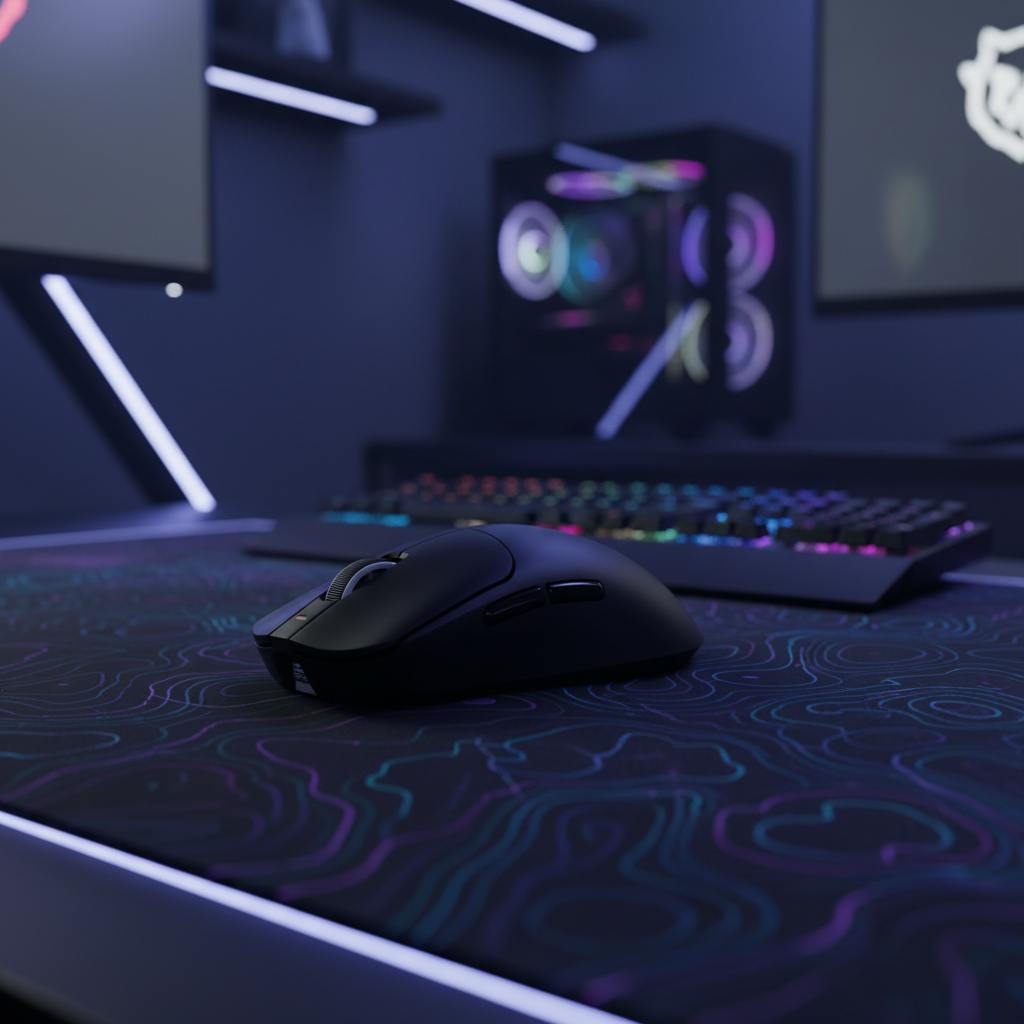
The optimal setup for low-sens arm aiming is a 60g-class mouse paired with a low-friction surface. A hybrid or carbon fiber surface, such as the ATTACK SHARK CM04 Mousepad, provides a consistent kinetic friction coefficient. This allows the mouse to glide effortlessly during the sweep while the player relies on the mouse's inherent 60g inertia and their own muscle control to handle the stop, rather than relying on the "tug" of a high-friction pad.
Technical Depth: Sensor Integrity and the DPI Trap
For the arm aimer, the sensor must be able to handle extreme "Inches Per Second" (IPS) ratings. During a violent arm sweep, a low-quality sensor will "spin out" or lose tracking because it cannot process the surface images fast enough.
Furthermore, there is a technical "DPI Trap" for low-sens players. Many competitive veterans insist on using 400 DPI because it was the standard for decades. However, our scenario modeling using the Nyquist-Shannon Sampling Theorem suggests that 400 DPI may actually be causing sub-pixel inaccuracies on modern 1440p displays.
Modeling Note: The Nyquist-Shannon DPI Minimum
To avoid "pixel skipping" (where the mouse movement is too coarse for the display's resolution), the sampling rate of the sensor (DPI) should theoretically be at least twice the Pixels Per Degree (PPD) of the display at your specific sensitivity.
Method & Assumptions (Scenario Model):
- Resolution: 2560x1440 (1440p)
- Sensitivity: 40cm/360
- FOV: 103°
- Result: Our analysis indicates a minimum of ~1150 DPI is required to maintain perfect pixel-to-count 1:1 fidelity. Using 400 DPI in this scenario creates a sampling deficit, which players often perceive as "smoothness" but is actually a loss of raw precision.
For this reason, high-performance sensors like the PixArt 3395 or 3950 found in the ATTACK SHARK X8 Series are essential. These sensors offer up to 750 IPS malfunction speeds and high native DPI ranges, ensuring that even at the 1600 DPI setting (which we recommend for 1440p competitive play), the tracking remains flawless during the fastest arm sweeps.
The 8000Hz (8K) Polling Revolution
As noted in the Global Gaming Peripherals Industry Whitepaper (2026), the industry is moving toward ultra-high polling rates. For an arm aimer, 8000Hz polling provides a more granular data stream to the PC.
- 1000Hz: 1.0ms interval between reports.
- 8000Hz: 0.125ms interval between reports.
While 1ms is fast, an arm sweep covers a lot of physical distance in that millisecond. At 8000Hz, the PC receives 8 times more updates regarding the mouse’s position. This reduces "micro-stutter" in the cursor path, which is particularly visible on high-refresh-rate monitors (240Hz+).
The Motion Sync Trade-off: Many high-end mice use "Motion Sync" to align sensor frames with USB polling intervals. While this adds a tiny amount of latency, at 8000Hz, that delay is reduced to approximately 0.0625ms (half the polling interval). For the precision-focused arm aimer, the consistency benefit of Motion Sync far outweighs this negligible latency penalty.
Technical Constraint: To utilize 8000Hz effectively, the mouse must be connected to a direct motherboard USB port (Rear I/O). Using front-panel headers or unpowered hubs can lead to packet loss and IRQ (Interrupt Request) bottlenecks, which will cause frame drops in-game.
Modeling the "Large-Handed Arm Aimer" (Persona Analysis)
We modeled a specific competitive persona to understand how hardware choices impact performance.
- Persona: Large-handed (20.5cm), Low-sens (40cm/360), Claw Grip.
- Hardware: 60g Wireless Mouse, 1440p/240Hz Monitor.
Findings:
- Fit Ratio: A standard 120mm mouse is roughly 9% too short for a 20.5cm hand using a claw grip. This often leads to "palm float," where the heel of the hand loses contact with the mouse, reducing stability.
- Weight Tuning: Players in this category often benefit from adding 1-2g of grip tape. This isn't just for texture; it slightly increases the width and provides the "stop feel" missing from ultra-light shells.
- Wireless Runtime: At 4000Hz polling, a 300mAh battery (typical for lightweight mice) will last approximately 13 hours. For competitive players, this necessitates a daily charging routine or the use of a high-quality cable like the ATTACK SHARK C06 Coiled Cable for wired play during long sessions.
Optimizing Your Setup: A Practical Checklist
If you are an arm aimer looking to master inertia, follow this technical optimization path:
- Target Weight: Aim for 60g to 65g. This provides the best balance of low kinetic energy and proprioceptive feedback.
- Surface Selection: Use a speed-oriented or hybrid pad with low static friction. Avoid thick, "muddy" cloth pads that hinder micro-adjustments.
- DPI Adjustment: If playing at 1440p, move from 400 DPI to 1600 DPI and lower your in-game sensitivity proportionally. This aligns with the Nyquist-Shannon sampling requirements for pixel-perfect tracking.
- Polling Rate: Use 4000Hz or 8000Hz if your CPU can handle the IRQ load. Ensure you are plugged into a rear USB 3.0+ port.
- Grip Customization: Use grip tape to fine-tune the width and "balance" of the mouse. A slightly rear-heavy balance is often preferred by arm aimers to help anchor the mouse during the end of a sweep.
Summary of the Inertia-Optimized Setup
The shift toward lightweight peripherals is not just a trend; it is rooted in the physics of kinetic energy management. By reducing the mass to the 60g range, arm aimers can significantly decrease the counter-force required to stop their mouse, leading to more consistent flick accuracy and reduced muscle fatigue. However, hardware is an ecosystem. The mouse must be supported by a high-IPS sensor, a high-polling wireless connection, and a surface that doesn't fight against the user's movements.
Understanding the "why" behind your gear—from the Nyquist-Shannon sampling limits to the IRQ processing of 8K polling—is what separates a casual player from a technical competitor.
Disclaimer: This article is for informational purposes only. Technical performance may vary based on individual system configurations, OS optimization, and human motor control limits. Always ensure your hardware is compliant with local regulations such as FCC Equipment Authorizations and ISED Canada standards.
Sources: